

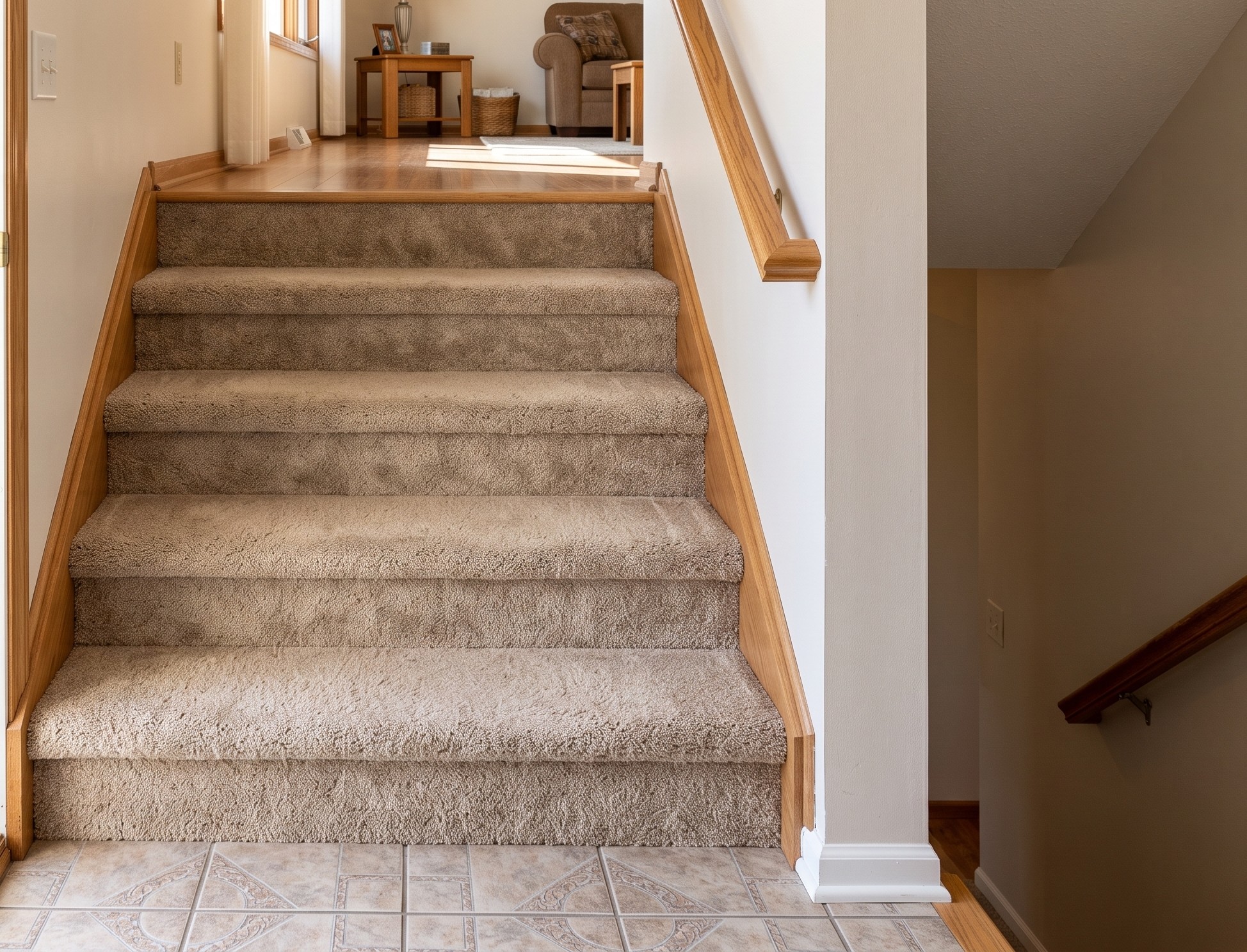
Twin Cities split-level entryways built throughout the 1970s and 1980s come with a distinct challenge every winter.
When you step inside from a snowstorm in Ramsey or Anoka County, sub-zero slush and gritty road salt track directly onto the small landing. Because these floor plans lack a mudroom buffer zone, everyone immediately pivots up to the main living area or down to the finished basement. Hardwood or smooth plank steps turn slick fast under wet boot soles, and uncarpeted wooden treads amplify heavy foot traffic across both levels of the house.
High-friction cut-pile carpet handles these foyer demands by providing slip resistance, protecting step edges from traffic wear, and muffling foot noise.
Safety and Grip on High-Traffic Steps
Stairways right off a split-entry landing need dependable traction underfoot. Moisture from boots or wet socks reduces friction on smooth surfaces, turning a quick trip between levels into a slip risk. Dense cut-pile carpet changes how foot pressure meets the step surface.
Cut-Pile Carpet for Step Grip
Cut-pile styles offer superior traction on steep stairways because of how the individual yarn tufts stand. The yarn ends are sheared flat across the top, leaving upright fibers that bend under your foot and press back against rubber shoe soles or socks. This physical resistance creates immediate grip the second your foot lands on the tread. The uniform pile also gives you a consistent footing across the entire surface of the step, so you do not encounter slick spots when you rush up or down.
Looped Carpet Risks on Narrow Treads
Continuous loop styles, like traditional Berbers, present specific drawbacks on split-level stairs. The closed yarn loops create a smooth, tight surface that offers far less friction underfoot than upright fibers. Pets can easily catch their claws in the loops as they run up the steps, which snags the yarn and pulls long runner lines out of the backing. When loop-pile bends over narrow stair steps, the tight rows of yarn can separate slightly, creating gaps that look uneven and feel slick under bare feet.
Durability Along the Stair Nosing
The front curved edge of each step takes the brunt of your weight with every single step. In busy split-level households, that repeated downward impact can crush inferior fibers within a couple of seasons, leaving the front edge looking flat and threadbare.
Dense Nylon Fibers That Resist Crushing
Tight-twist nylon yarns handle continuous downward pressure without matting down. The fibers are wound tightly and heat-set, which helps each yarn tuft bounce back to its original shape after someone steps on it. This fiber strength prevents the unsightly worn path that often ruins the center of high-traffic steps. A short, dense pile also wraps cleanly over the wood nosing without bending open or exposing the structural backing underneath.
Noise Control Between Living Levels
Split-entry architecture creates an open sound tunnel between your upper and lower floors. Hard stair treads act like sounding boards, sending loud foot strikes and creaks through the wooden stringers and straight into the lower-level family room or upstairs bedrooms. Adding a dense textile layer breaks this acoustic path before vibrations reach the framing.
Footstrike Noise Reduction with Dense Carpet
Dense carpet fibers act as a sound barrier directly over the wood. When foot strikes hit carpeted steps, the dense cut-pile absorbs the physical impact before that vibration can transfer into the floor joists and wall studs. The textured surface also prevents sound waves from bouncing off the drywall in the tall foyer ceiling. This material barrier cuts down the hollow, echoing thumps that travel through the house whenever someone uses the stairs.
Professional Installation Details for Split-Level Steps
Stair installations demand exact fitting to keep the material secure and prevent loose fabric over time:
Custom Hollywood Upholstery: Installers staple the carpet tight under the lip of the tread and flush against the riser for a crisp, tailored look that stays put.
Dual Tack Strip Anchoring: Installers place heavy-duty tack strips along the back crotch and bottom of each riser to lock the backing under permanent mechanical tension.
Precise Seam Direction: Installers align the carpet pile nap to run downward from top to bottom, which helps the fibers resist wear and hide fasteners.
Get Expert Stair Carpet Advice in New Brighton
Upgrading your split-level staircase with the right carpet creates a safer, quieter entryway that handles daily Minnesota foot traffic. You do not have to guess which pile density or fiber type will hold up best on your steps.
Our local team helps you compare durable cut-pile textures and find the right fit for your home layout. Because we stock hundreds of rolls in our 9,200 sq. ft. New Brighton warehouse, you can get ready-to-install carpet without long shipping delays.
Visit our showroom to see our in-stock cut-pile options, or contact us today to set up a free in-home measurement with our team.


